
Guide
How to size a power station for home backup: a worked example
Watts, watt-hours, surge, and inverter losses, explained with a real outage scenario, so you can pick the right capacity before you buy anything.
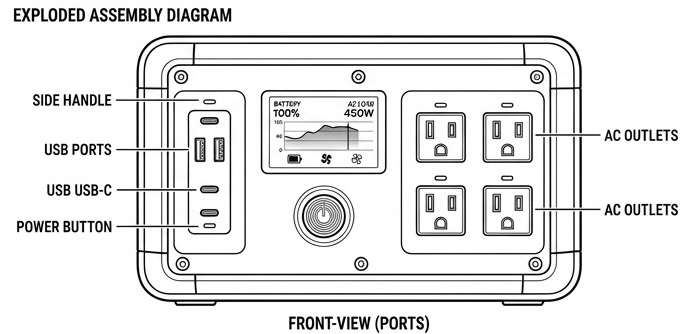
The most common mistake in buying a portable power station is shopping by the biggest number on the box. Capacity, continuous output, and surge output answer three different questions, and you need all three to be right. This guide walks through the math using a realistic outage, and uses the VoltPak 1000's design specifications as the example unit.
The VoltPak 1000 has not started shipping. Figures quoted for it here are design targets and will be confirmed against measured data before launch. The method itself works for any power station.
Three numbers, three questions
| Number | Unit | Question it answers |
|---|---|---|
| Capacity | watt-hours (Wh) | How long can it run my stuff? |
| Continuous output | watts (W) | Can it run everything at once? |
| Surge output | watts (W) | Can it start motors and compressors? |
Watts are a rate; watt-hours are an amount. A 100 W load running for 10 hours uses 1,000 Wh.
Step 1: list what you actually need to run
Write down each device, its running watts, and how many hours it will actually run over the outage. Nameplate ratings are a ceiling, not an average, so where you can, use a plug-in energy meter for a day.
| Device | Running watts | Hours in 12 h | Energy (Wh) |
|---|---|---|---|
| Fridge (compressor cycles ~40%) | 150 | 12 × 0.4 = 4.8 | 720 |
| Wi-Fi router + modem | 20 | 12 | 240 |
| Laptop | 60 | 6 | 360 |
| 3 phones charging | 30 | 4 | 120 |
| LED lighting (4 bulbs) | 40 | 5 | 200 |
| Total | 1,640 Wh |
Peak simultaneous draw here is roughly 150 + 20 + 60 + 30 + 40 = 300 W, far below any modern unit's continuous rating. Capacity is the constraint.
Step 2: account for losses
Converting battery DC to 120 V AC is not free. A typical inverter is somewhere around 85–92% efficient, and it also burns a small amount of power just being on. Plan on usable AC energy being about 85% of the rated capacity, and don't plan to drain a pack to exactly 0%.
A 1,024 Wh unit would cover roughly 7 hours of this exact list, not 12. That's a useful result, because it tells you what to change:
- Run the fridge only, plus the router, for the long haul (about 960 Wh → 13 h on one unit at 85%).
- Charge laptops and phones during the day from a car or solar.
- Add an expansion battery (VoltPak's design allows stacking) or solar to stretch runtime.
Step 3: check surge for anything with a motor
Compressors, well pumps, and power tools draw a large inrush current for a fraction of a second when they start, often 3–7× their running watts. If your fridge runs at 150 W, plan for a start-up of up to about 800–1,000 W.
For the VoltPak 1000 the design targets are 2,200 W continuous and 2,600 W surge, so a fridge start is comfortably inside the envelope. A 1 HP table saw or a 15,000 BTU air conditioner is not a good match for any unit this size. Check the label on the appliance for "LRA" (locked-rotor amps) and multiply by 120 V for a worst-case surge.
Step 4: sanity-check with three rules of thumb
- Never size to the exact number. Add 20–25% margin for cold weather, battery aging, and loads you forgot.
- Heating loads are off the table. Space heaters, kettles, and electric stoves draw 1,000–1,800 W continuously and will empty a 1 kWh pack in under an hour.
- Cold matters. Lithium batteries deliver less capacity in the cold, and LFP packs should not be charged below freezing. See our post on why we chose LFP.
A quick worksheet
If you'd like a second opinion on your own list, send it to us through the contact form and an engineer will take a look. To hear when the VoltPak 1000 is ready to order, join the Launch List.