
Design Philosophy
Function dictates form.
Every decision in a VoltPak starts with a question: does this serve a function? If the answer is no, it doesn't ship.
Open hardware
The hardware is yours to study.
Every VoltPak PCB - the main inverter board, the BMS interface, the USB-PD controller - is released as open source under the CERN Open Hardware Licence v2 (Strongly Reciprocal). KiCad schematics, PCB layouts, STEP mechanical models, and a full BOM with Mouser/DigiKey part numbers will be published on this site at launch.
We do this because we believe hardware you can understand is hardware you can trust. We also do it because a community of engineers poring over your design finds things you missed, improves things you got lazy on, and builds mods that make the product better.
The CERN-OHL-S licence means you can study it, modify it, and manufacture from it - as long as you release your changes under the same terms.
- ✓Inverter board - schematic and PCB layout (KiCad 7)
- ✓BMS interface board - schematic and PCB
- ✓USB-PD controller board - schematic and PCB
- ✓Chassis STEP and IGES mechanical models
- ✓All STL files for user-replaceable panels
- ✓Full BOM with manufacturer PNs
The MCU firmware is proprietary. It's our primary engineering moat - the control logic, protection algorithms, and display stack took years to develop and are what separate a good inverter from a reliable one. We don't publish it. The community is welcome to reverse-engineer it. Builders who go deep and share findings in our Discord get hardware, pre-release units, and direct engineering access.
Join the firmware RE community →The brief
What we tell ourselves when we design.
Softened edges where tooling demands it. Nothing else. The shape should communicate purpose, not brand personality.
If there's a vent opening, air moves through it. Decorative geometry that implies airflow is dishonest design. We don't do it.
Matte ABS. Industrial grain texture. Hides wear. Survives a bench. Doesn't fingerprint. Consumer gloss finishes don't belong on tools.
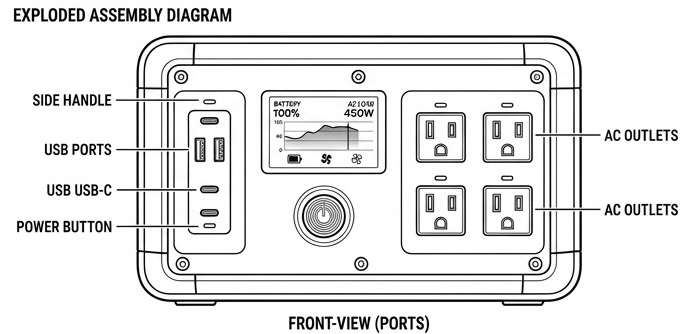
Standard M3 Phillips or hex socket throughout. Visible and reachable. Anyone with a screwdriver should be able to open this product.
LEDs exist to convey state - per-port status, not ambiance. The display is a dashboard, not a brand moment.
Battery compartment isolated. Fans on standard bolt patterns. Panels replaceable. The architecture invites modification.
Aesthetic references
Where the visual language comes from.
The target feeling is somewhere between Blade Runner utility and Dune's brutal material honesty. Sci-fi with restraint. Futurism that earned it.
Color palette: graphite, charcoal, desert tan. UI accents: white, amber, cold blue - used sparingly. The accent colors on the display and LEDs are instrument colors, not brand colors. They mean something.
When someone sees a VoltPak on a bench, the goal is for them to think: "I could open that. I could understand that. I could make it mine."
"That feeling is the product."