
Company
Where VoltPak stands in the open-source hardware world
We publish schematics, PCB Gerbers, enclosure STLs, and a bill of materials for every unit we ship. Here's why - and where we draw the line between open hardware and open firmware.
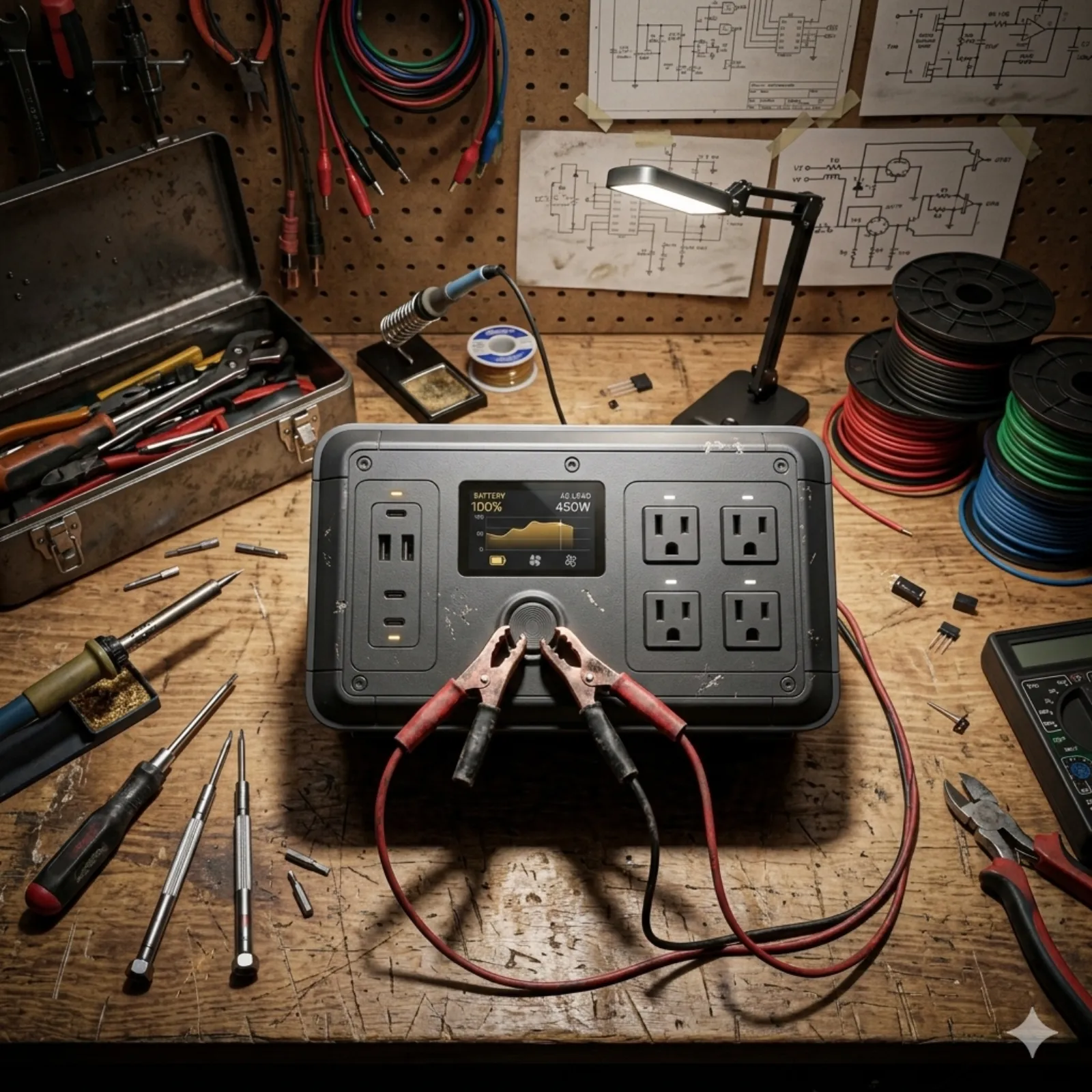
Every VoltPak 1000 ships with a QR code on the back panel that takes you to the full hardware source - schematics, Gerbers, BoM, and the STL files for every printable bracket and mount. You can download the whole bundle right now:
Most consumer electronics companies don't do this. Most of them actively don't want you to know what's inside the box. So it's a fair question to ask: why?
The short answer is that we think the consumer electronics industry made a wrong turn about fifteen years ago when it started pretending hardware was a trade secret. The long answer is below.
The hardware-open, firmware-closed model
Let's get this out of the way first, because it's the thing that draws the most heat from the community: our firmware is not open source.
The bootloader is signed. The control-loop code is not published. We do publish the register-level interface, the CAN/BMS protocol, and enough information for anyone to write their own firmware - but we don't ship the source for ours.
Hardware is a statement of design. Firmware is a statement of safety. A user can swap a MOSFET and worst-case kill their own unit. A user with write access to our control loop can brick the OVP trip threshold and kill someone else's house. Those two risks aren't symmetric, and we don't think they should be treated symmetrically.
We talked about this choice for months internally. The conclusion was that the thing that actually benefits users - the ability to understand, repair, and extend the hardware - is preserved by open schematics. The thing that would put users at risk is a signed firmware chain you can't bypass. So that's what we shipped.
Not everyone agrees with this. That's fine. We'd rather be honest about the trade-off than handwave it.
What "open" means in practice
A lot of companies use the word "open" to mean "we published a photograph of the PCB." That's not open. Here's what shipping open hardware actually looks like for us:
- Schematics - full KiCad sources plus rendered PDFs. Every net labeled. Every part number searchable.
- PCB Gerbers - production-ready fabrication files, not screenshots. You can send them to JLCPCB tomorrow.
- BoM - every component, manufacturer, part number, substitution notes, and the assembly process class for each part.
- Mechanical - STEP files for the enclosure, STLs for every printable bracket, and the DXF for the front panel.
- Errata - we publish mistakes. There's an errata document in the bundle. VoltPak 1000 errata rev A lists three issues we caught in DVT and fixed in production.
The point is that someone technical should be able to take the bundle, sit down, and rebuild a functionally-equivalent VoltPak 1000 on their own. That's a pretty high bar. It's the bar we aim for.
What the STLs unlock
Some of the coolest things users have done with VoltPak in the first six months were mechanical, not electrical. People have printed custom mounts, rack ears, desk tilts, fan guards, and battery housings. We ship STLs for the ones we're proud of:
The economic argument
The usual pushback we hear is: "If you publish everything, won't someone just clone you?"
Two things are true about this.
First, yes, people can clone us. There are already two Alibaba listings that look suspiciously like our PCB. This doesn't bother us much. If someone wants to manufacture a VoltPak clone at scale, they need access to the same transformer winder, the same MOSFET supply, the same enclosure tooling, and the same QA jigs. Hardware at this level is a capital-intensive game; the schematic is maybe 5 % of the moat.
Second, and more importantly, openness compounds into trust. The number one reason our early customers bought a VoltPak was that they could look inside it before buying. That's worth more to us than the speculative downside of a knockoff that - let's be real - won't have OVP or OCP and will get one-star reviews six weeks after it ships.
Where we want the space to go
We'd love to see open hardware become the default for power electronics consumer products, not the exception. Specifically:
- Published schematics as a condition of safety certification.
- BoM transparency for repairability - if you can't source the part, you can't fix the thing, and that's landfill by design.
- Errata culture - publishing mistakes openly as a signal of technical maturity, not weakness.
We'll keep writing about where we think the space is going. If you want to build with us, the bundle is there. Break it, fork it, improve it, or just read it and understand what's in your box. All three are wins.
If you're working on an open hardware project in the power electronics space and want someone to read your schematic or compare notes on safety trip thresholds, reach out. We've been there and we'd like to help. Email engineering@voltpak.ca.